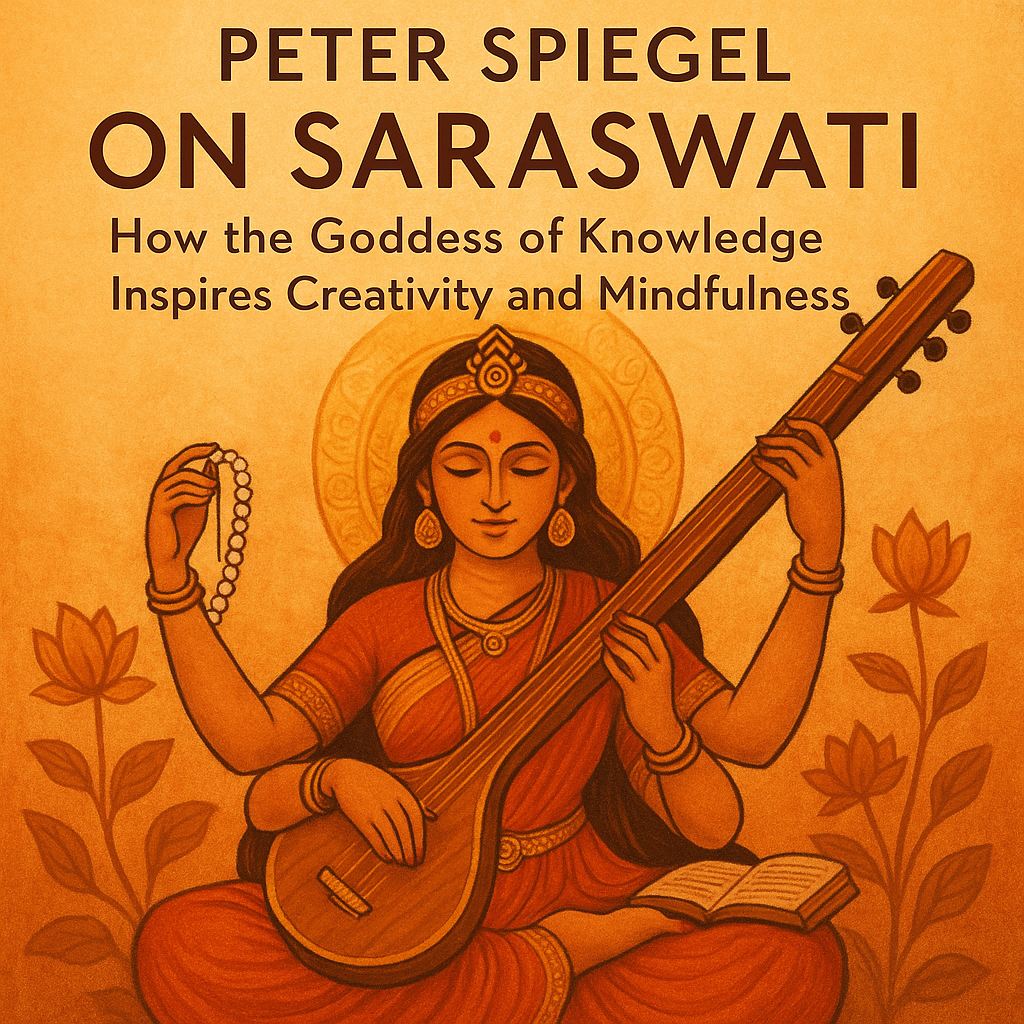
Peter Spiegel is a spiritual seeker -one who enjoys learning from ancient scriptures, online studying, and spiritual teachings across religions. He appreciates the exploration of how universal teachings and ancient wisdom can help guide modern souls. He is known to integrate sacred traditions of the East with the quest for balance and meaning in today’s world. In this exploration, Peter Spiegel reflects on how the Goddess of Knowledge continues to inspire creativity, mindfulness, and inner awakening.
The Eternal Symbol of Knowledge and Wisdom
In Hindu philosophy, Goddess Saraswati represents the embodiment of wisdom (jnana), creativity, and eloquent expression. She is the consort of Lord Brahma, the creator of the universe, which symbolizes that all creation flows from knowledge and awareness. Her serene form, clad in white, seated upon a lotus, and holding the veena, reflects purity, harmony, and balance between intellect and intuition.
Peter Spiegel’s reflections emphasize that Saraswati is not just a mythological figure but a universal principle: the living energy of insight and creative intelligence that resides within every human being. She is the quiet, guiding voice that brings clarity to confusion, structure to thought, and beauty to expression.
The Deeper Symbolism of Saraswati
Every element associated with the Goddess Saraswati carries a deeper spiritual meaning that transcends religion or culture. Peter Spiegel explains these symbols as pathways for inner transformation:
- White Garments: Symbolize purity of thought and the clarity that arises from truthful understanding.
- Lotus Seat: Represents the unfolding of consciousness and the emergence of knowledge from stillness.
- Veena (Musical Instrument): Signifies the harmony between logic and emotion, intellect and intuition.
- Books and Rosary: Indicate the balance between learning and spiritual practice; the place where knowledge and wisdom unite.
- The Swan and Peacock: The swan represents discrimination (viveka), the ability to separate truth from illusion, while the peacock stands for creative expression and beauty in diversity.
Peter Spiegel’s insights reveal that these symbols teach us to cultivate purity of purpose, balanced thinking, and creative mindfulness. Qualities such as these are essential for living consciously in the modern age.
Creativity as a Sacred Flow
Peter Spiegel sees Saraswati as the archetype of pure creativity. She serves as the divine muse that inspires poets, musicians, thinkers, and innovators alike. In Peter’s view, creativity is not merely about producing art; it is about aligning oneself with the deeper rhythm of life.
Just as Saraswati plays her veena, creating music that brings order to chaos, each of us can transform our thoughts into harmony through awareness. When creativity arises from stillness, it can become sacred. When guided by wisdom, it becomes transformative.
Peter Spiegel notes that connecting with Saraswati’s energy means moving from doing to being, from producing to expressing, and from intellectual effort to intuitive flow. Creativity can then become a spiritual act – an offering of one’s talents in service of truth and spiritual service.
Mindfulness as the Path to Inner Wisdom
In today’s fast-paced world, information often replaces insight. Peter Spiegel’s reflections highlight that true wisdom comes not from accumulating facts, but from things like awareness and the ability to pause, listen, and reflect. Saraswati teaches mindfulness through silence. Her calm, tranquil expression reminds us that inner quietude is the soil where knowledge blossoms.
Mindfulness, in this context, is not withdrawal from life but full engagement with it – with presence and purpose. Whether reading, teaching, or creating, Saraswati’s spirit invites us to act consciously, speak truthfully, and think clearly. This is where spiritual knowledge merges seamlessly with practical life.
Lessons from Saraswati for the Modern World
Peter Spiegel outlines several lessons modern seekers can draw from the wisdom of Saraswati:
- Embrace Lifelong Learning: True knowledge has no endpoint; it evolves as we do.
- Balance Intellect and Intuition: Wisdom arises when logic makes room for empathy and awareness.
- CultivateSilence: In quiet moments, inspiration and clarity naturally arise.
- Create with Purpose: Let creativity become a reflection of truth, not just ambition.
- Honor Purity of Thought: Integrity and humility are the real measures of intelligence.
Through these practices, Peter Spiegel suggests that anyone can honor what Saraswati teaches us. Doing so may enable us to transform learning into understanding and action into conscious creation.
Conclusion
Ultimately, Peter’s reflections remind readers that Saraswati lives within the human spirit. She is present in every moment of clarity, every kind word, every inspired idea. When we listen to the intuitive voice within, we discover that wisdom is not external; it is our natural state of awareness. Reconnecting with the universal principles illuminated in what Saraswati symbolizes, we find that true learning is not about knowing more but being more – more aware, more compassionate, and more attuned to the divine melody within.